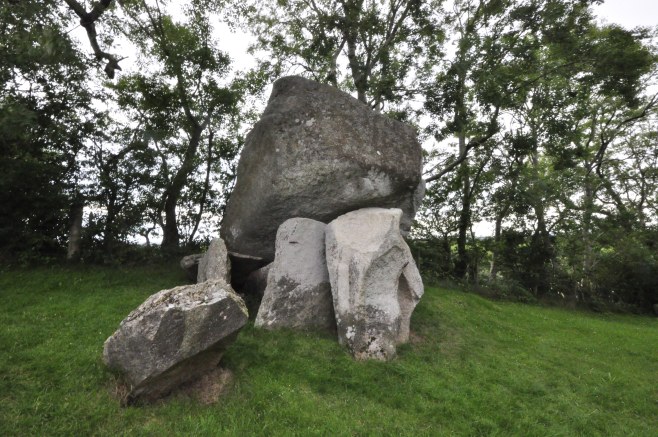
While approaching the end of my 680 kms cycling pilgrimage along the proposed Turas Columbanus I took time to make a mini pilgrimage to Goward Dolmen in the Parish of Clonduff, County Down.
The reason being my aunt Madge is married to Pete Kearney and they have lived in Mittagong New South Wales for many years. The Kearneys originally hailed from Goward, but there are no Kearneys living in the old parish now.
While cycling out of Hilltown in the rain recently I asked an elderly lady if she knew of Pat Kearney’s Stone and she gave me good directions. But she wasn’t aware of any Kearneys from the area. As I turned onto the laneway I could see that the furze bushes had been cut and the lane was littered with thorn branches. Between the rain and the thorns I decided not to venture the mile or so off route and planned to visit on my next leg of the journey.
On Tuesday I completed Turas Columbanus to Bangor and on my return via Hilltown, I drove to Pat Kearney’s Big Stone.
Pat Kearney’s Big Stone
Pete’s father, also Peter, carried out detailed research some years ago, along with his wife and established where their ancestors were from and he came across a photo of his great grandfather sitting on a ledge beside the big stone.
Petes’ brother Michael sitting alongside the Stone, recreating the photo of his Great Grandfather from 1850
The first member of the family to visit the Stone was Pete’s son, and our first cousin, Jason, who was sent on a mission by his Grandad to visit the Stone and take photos. Pete and members of his family subsequently visited the area some years back and completed walks from Kilbroney to the Stone thus honouring their ancestors and their home place. Pete just provided me with the following detail about the Kearney family of Goward and Pat Kearney’s Big Stone.
I never in my wildest dreams imagined spending two nights of my holidays in Banagher! If there is a positive to Covid-19 it is that we are looking afresh at how we spend our time and where we spend it.
Growing their own grapes on Main Street Banagher!
#Staycation is the new buzzword and holiday at home is the only recommended option. Avoiding Covid hotspots and crowded venues should be the norm if we are to restrict the spread of Covid.
On the plus side we are looking at our own country in a different way; we are seeing the beauty in the ordinary and loving it. We spent the last week exploring Ireland’s Hidden Heartlands and its Ancient East – never quite sure where the demarcation line is between the two!
The Mighty Shannon
One thing for sure is that the welcome is genuine, there is nothing ‘fake’ about the friendliness of people that you meet, which sometimes I question when I visit tourist hotspots along our coasts.
It was our first time to hire a boat and my only regret is we didn’t do it years ago! It was the perfect way to social distance and to see places along the Shannon from a different perspective. Time stands still as the boat moves so slowly! Great to see groups of young people thinking likewise and hiring small boats and barges for a holiday with a difference – they don’t deserve the blame they are getting for the increase in the spread of Covid – they are no more responsible than every age group..
Stopping off in tiny villages such as Dromineer and Terryglass was just perfect; some great local pubs with great food, great walking and cycling routes too.
Lough DergWalking Slí Eala near Dromineer
The Shannon region is steeped in history and there are some amazing sites to visit. Is there a more scenic setting for a monastic site than famed Clonmacnoise? The English and the Vikings have a lot to answer for in relation to our heritage sites. They reduced so many of them to ruins and destroyed such important parts of our history.
Temple Ciarán, reputed burial place of St Ciarán who founded the monastery in 548 AD.The beautifully carved South Cross with the Cross of the Scriptures and the Round Tower behind.
Not far away along the byroads of Offaly is Lough Boora Discovery Park and The Offaly Way where we got to take in some lovely cycling routes across a corner of Offaly I’ve seldom visited.
West of the Shannon, Portumna Forest Park covers an impressive 1600 acres and has some incredible single trail cycle tracks. Home to a herd of fallow deer and its possible to spot the White Tailed Sea Eagle from the bird hide on the Lakeshore.
20kms of single trackThis is a Turlough! A disappearing lake, common in limestone areas especially west of the Shannon. Portumna Pier
One of the highlights of our trip was a visit to the stunningly beautiful and simple Meelick Church – the oldest church in continuous use in Ireland, Built in 1414 AD it is still in daily use.
Meelick Church, founded by the Franciscans in 1414 AD.Meelick Church
Seven days exploring a region that we would normally pass through proves yet again that every county has so much to offer, if we only take the time to visit and explore. Look with new eyes, try something different, use your two feet and explore the great outdoors! We give out about the weather but in reality there is no such thing as bad weather only bad clothing! Stay home this year, spend a few bob in our own country and help small businesses stay afloat and hopefully thrive!
I love getting a Saturday afternoon to explore a bit of our historic and fascinating county. Today I went down South – again to the Rathanna, Ballymurphy area.
A phone call from Eamon Coleman a couple of months ago to tell me that he had cleared a path to the ancient rock art and holy water wells that are situated on his land had me planning to head down when football commitments allowed.
First port of call was Killoughternane
This single cell Church was built in the 5th Century by St Fortchern. There is a well across the road that has a really interesting history. It was forgotten about until 1880 when the land owner found a bottle with a message inside, written in a foreign language which when translated contained directions to the well! It must have attracted visitors from continental Europe at some point. This obviously created great excitement and the Well became a pilgrimage site with may cures attributed.
Subsequently a lady was cleaning out the well when she unearthed a mud encrusted item from the bottom of the well. It turned out to be a Chalice and Paten – probably hidden in penal times. The Chalice is now in St Andrews Church, Bagenalstown.
Headed over to Tinnecarrig Ballymurphy then to meet Eamon Coleman and view the rock art that is well hidden from view in an ancient overgrown graveyard on his land.
Its hard to make out the cups on this stone but if you look carefully you can see many deep cups peppered all over the surface. What did they signify? Who knows at this stage but its great see that rock art many thousands of years old is still present across the county.
Indeed you could say that this area is the Boyne Valley of the South as there are numerous examples close to the foothills of the Blackstairs!
One of the Holy Wells well hidden from view.
Holy wells or water fonts….
Time to head home but a short dash across to Rathgeran and Carlow’s finest example of rock art beckoned.
There are many more ancient heritage sites in this small area of the County – I often think we undersell what we have to offer…
I never gave much thought to the First World War. Sure I learned about it in history class but our interest in history would have been Irish history and while we did cover WW1 I don’t remember talking very much about the loss of life suffered by the thousands of Irish men who fought in The Great War.They fought for a variety of reasons – many fought to put food on the kitchen table, others for the promise of Home Rule yet others fought for the Crown and ‘the freedom of small nations’. I guess we were ambivalent about it at best. Yet almost 50,000 Irishmen lost their lives in the most inhumane conditions imaginable.
In 2010 I was fortunate, along with my youngest son Ronan, to have the opportunity to cycle from Canterbury to Rome along an ancient pilgrimage route, The Via Francigena. That was an amazing experience in so many different ways but perhaps the most unexpected was that it brought WW1 right into the present day for both of us. Our planning hadn’t factored in that we would be cycling through areas of France that were in the front line of battle. It was a shock to the system to suddenly come across, on Monday 6th September, small beautifully kept cemeteries along the 60kms of backroads of France between Arras and Peronne.
We stopped and paid our respects at each little graveyard and it was one of the most emotional places and moving things I have ever done. It really brought home the futility of war to walk among row after row of identical white memorial headstones and read the ages of these teenage soldiers who all died in vain, for the nations of Europe were to repeat those mistakes again and again.
I’ve edited out a little video clip at the end of this blog post of our visit to one of the cemeteries as a gesture of remembrance for all the dead on both sides and the civilians who were caught up in this most brutal conflict.
It was lovely to see how well maintained all the cemeteries were.
This post is to mark the one hundred anniversary of Armistice Day and to help us not forget.
Allied War memorial between Arras and Peronne
Respectfully maintained WW1 cemeteries are to be found on the back roads of France. There are many more than the more well known major memorials and serve as a reminder of the futility of war.
Hindu Soldiers honoured
Four years later I was back in France and cycling in the Lyon area and I went astray taking what turned out to be a very long shortcut! But it was very interesting and I came across a WW2 graveyard as poignant as coming across the WW1 graveyards in 2010. But this was even more surprising for this was a cemetery for almost 20,000 German soldiers at a place called Dagneux.
Dangeux WW2
The war graces site at Dagneux was developed by the German War Graves Commission with the permission of the French Authorities during the 1950s and 1960s.
Pilgrimage is back in fashion.Over 300,000 obtained the Credencial upon completion of the Camino Santiago in 2017, the ancient pilgrimage routes across Spain to the tomb of St James.
Old pilgrimage routes are being revived across Europe as people try to find a greater meaning in life or maybe just go for a long walk!
The Pattern at St Mullins is a 1300 hundred year old tradition linked to St Moling and St James. It is linked ot St James because the date is set on the Sunday before July 25th, the feast day of St James.I wonder was it ever a starting point for the Camino?
Each year thousands gather here to commemorate St Moling and to visit the graves of this picturesque graveyard and monastic site. The pilgrimage starts with the blessing of the water of the well with pilgrims drinking the water which reputedly has been responsible for many cures down the centuries. The water from the well flows through the mill race that Moling dug out over a period of 7 years Mass is then celebrated at the penal altar in the centre of the graveyard. During the time of the Penal Laws, celebration of mass was outlawed and had to be celebrated in secret and a lookout would have been placed on the nearby motte.
St Moling has attracted pilgrims here for hundreds of years to the monastery he founded in the 7th century; it is Carlow’s Clonmacnoise – the Book of Moling can be seen ion Trinity College, Dublin alongside the more famous Book of Kells.
The graveyard holds many famous remains, from St Moling himself, to Art Kavanagh, King of Leinster who was buried here in 1417 having been poisoned in New Ross. There are many graves associated with 1798 including General Thomas Cloney who died at the age of 24.
With the revival in pilgrimage across Europe, there is surely great scope to develop a Carlow pilgrimage route considering the number of really ancient and important ecclesiastical sites across the county associated with St Moling, Columbanus, St Fiacre, St Laserian and others.