Rothar Routes

Cycle routes & pilgrim journeys in Ireland and Europe …..

Posts tagged ‘Turas Columbanus’

Rathanna Cycle Hub ?

Looking for a place to plan some nice cycle routes from? The tiny village of Rathanna would make a great cycle hub for south Carlow, south east Kilkenny and Wexford around the Blackstairs. Located between Borris and the Blackstairs Rathanna is perfectly positioned for exploring the Blackstairs Mountains, using tiny traffic free local roads, where time seems to stand still.

Equip yourself with the absolutely brilliant ‘Blackstairs, Mount Leinster & The Barrow Valley’ map produced by East West Mapping (they are based in Clonegal, and produce a series of maps ideal for hiking and cycling activities) and you will have the complete picture to create a multitude of scenic and historically interesting routes that will have you coming back for more.

The history of Ireland and all our local communities is bound up in the richness of our original Irish place names. Every townland, hill and river has a name that tells a story – it might relate to the landscape, to the people who lived there, historical events or ancient mythology. This part of Carlow is rich in heritage. The place names reveal long forgotten aspects of our past – monasteries, churches, battle sites, folklore… they still live on and these connect us with our past despite the angliscation of our country which deliberately mistranslated their original meaning. That’s a pet hate of mine; I hate to see modern housing estates adopting typically English names such as … Tudor Downs or other such pretentious nonsense, when we have so many meaningful options in our original names and heritage to choose from.

In an era of rapid globalisation, preserving local placenames helps maintain a connection to the past. They are not just markers on a map; they are living records of the Irish language, our history, and our identity. For those interested in genealogy, researching placenames can reveal ancestral links and provide a deeper understanding of family roots.

And economically, for tourism and cultural heritage, the meanings behind placenames can enhance visitors’ appreciation of the landscape. Many tourists are fascinated by the poetic and descriptive nature of Irish placenames, which add depth to the country’s storytelling tradition. This quiet part of Carlow has its own unique charms, just waiting to be explored.

This is a great route with plenty of climbing featuring breath taking scenery and a magnificent narrow strip of tarmac with a huge drop down the mountain side if you get too distracted by the views! I started out at the car park opposite St Fortcherns Church in Rathanna and beside Osbornes tiny pub (which also has a hostel attached), it’s a gentle start, gliding downhill to Jack Carrolls bridge over the Killedmond river and on to the ‘Bull Ring – a unique little pentagonal piece of ground shaped by the surrounding network of roads and from where the climb starts to gently rise. It rapidly becomes very steep approaching Tomduff Crossroads and the approach road to Mount Leinster. Use the excuse of taking in the views to take a break from the fairly savage gradient as you head up towards the famous Nine Stones and the Columbanus Bell which marks the starting point of Turas Columbanus, a pilgrimage route, linking Carlow and Bangor in County Down.

The Nine Stones is a very popular spot for Sunday drives and the short walk up Slievebawn or the more challenging road to the TV transmitter on top of Mount Leinster.

I was delighted to bump into Carlow’s finest dual player ever, Paddy Quirke, here at the Columbanus Bell; he was out with the family for some fresh air and a ramble. Naomh Eoin’s finest played Railway Cup with Leinster and was a dual All Star Replacement. He looks as fit as ever!

The views across the patchwork of green fields of County Carlow stretch out before you as far as the eye can see; it’s not a road for the feint hearted and it’s always important to be cautious when meeting a car as it can be quite daunting to an inexperienced driver. If the pace uphill to this point was tortoise like, the descent down past the Head of the River Burren was an adrenalin rush!

The source of the River Burren. I was once inspired by a tale of the great Gus Merne who walked from here to Carlow following the path of the Burren and I undertook it many years ago but didn’t quite get back to Carlow town by dark!

My favourite place name in Carlow is ‘Cúl na Sneachta’. Situated at the base of Mount Leinster, the road follows the contour of the hill around in a sweeping arc and I noticed a memorial stone I hadn’t seen before. I pulled hard on the brakes and made out the inscription s best I could and it said ‘Cathal Goulding’ but I couldn’t really make out the rest of it. I looked to up when I got home and it transpires it was erected in memory of Republican, Cathal Goulding (1923-1998) who was ‘Chief of Staff’ of the IRA and the ‘Officials’. I hadn’t heard of his connection with the area but he had spent a lot of time in his cottage at Raheenleigh. Following his death, he was cremated and his ashes were scattered at the Nine Stones. You learn something new every day!

A bit further on I turned back left in the direction of Rathanna at a cross roads, where there’s a famous piece of rock art on display in the garden of a house at the cross roads. From there I headed up onto what I dubbed ‘The Hidden Sky Road’ some years ago and which Carlow County Council signposted as a local cycling route. I love this road that skirts the western side of Tomduff, towering over Rathnageeragh Castle and the former National School. I don’t think I’ve ever encountered a car on this road – nor another bike either!

Rathnageeragh NS in ruins, I took this a good few years ago.

Now transformed!

It was another downhill by Seskinamadra – Seisceann na Madraí, the marsh of the dogs… where I swung right and stopped over to visit St Fortcherns Well and Killoughternane Church ruins.

Despite it association with miraculous cures, I wasn’t tempted to have a ‘cuppa’ but clearly, other brave souls do and if the presence of frogspawn is an indicator of clean water, then I’m sure it would have done me no harm at all! A famous chalice and patten were discovered here that date back to 1595; they were hidden during penal times. There’s great reading about the history of the well and the area in the Myshall and Drumphea parish website.

Killougternane Church is a beautiful example of an early ChristianChurch dating back to the 10th century. It’s a beautiful serene place to visit and the stone work is immaculate.

Also known as ‘The White Church’, this 10th century granite church is built on the remains of an earlier timber church founded by St Fortchen in the 5th Century. Local wisdom holds that Christianity was established here even before the arrival of St Patrick. Who knows for sure.. ‘Cill Uachtair Fhionáin’ meaning the ‘upper church of Finnian’ highlights its connection with St Finnian of Clonard (but really of Myshall!), one of the greatest monastic sites in the country where the ‘Irish Apostles’ were all educated.

I skirted around by Knocksquire and traced my way back to Rathanna via Killedmond after a terrific afternoon cycle, sightseeing and exploring our local heritage. Good to be able to do it!

My Say on The Barrow Way..

We leave tracks wherever we walk. For thousands of years man has followed rivers inland, forging new paths, seeking shelter, food, searching for places never visited before.

In whose footsteps do we wander when we thread The Barrow Way?

We have few wild places remaining which is why The Barrow Way is so special in today’s fast paced world.

Columbanus travelled this way on his journey to Cleenish Island in Fermanagh where he began his education before his onward journey to Bangor in County Down. It’s ironic that now the we are trying to create Turas Columbanus or the Columban Way, (which will follow the Barrow Way to Monasterevin), we are again talking about developing the Blueway Cycle Path. We need clarity about what we intend to do with the Barrow Track. It cannot be a long distance walking trail and a cycling path. Surely it’s one or the other?

Countless people working on the barge traffic that serviced industry and agriculture were very familiar with this route once the canal network was created. It was a lot busier in the 19th Century than it is today!

Today it is designated a Special Area of Conservation. Or at least it was.

Tracks and Trails..
The longest continuous off-road walking route in Ireland is again under threat….

Proposals are due to come before the Local Authority to revisit the Barrow Blueway decision. The Blueway, specifically the replacement of the grass surface with a hardcore surface to facilitate cycling, put forward by Waterways Ireland a few short years ago was refused by An Bórd Pleanála following an unprecedented level of local objections to the proposal. I sincerely hope the proposal will not reverse the decision to remove the grassy path.

The grassy towpath, soft underfoot, a pleasure to walk on.

Unfortunately it appears that the views of the hundreds of people opposed to the Blueway is not being reflected in the debate and I want to put my thoughts out there before a vote is taken as I fear we face a fait accompli, without due consideration of the reasons the proposal was rejected.

The plan for a cycling path is linked to very laudable plans for a network of linked Greenways. Most of these Greenways utilise disused railway lines where they once existed- The Western Greenway, The Waterford Greenway, The Old Rail Trail, The Limerick Greenway, while there is also one on the Royal Canal and another on the River Suir. I have made it my business to cycle all of them over the past few years with the Limerick one being completed on a cold 31st December last.

There literally isn’t enough room for a shared path, as this short video shows! Imagine multiple cyclists (WWI forecast 50,000 Germans!) approaching from the front or behind anybody walking on this path..

I make the following observations based on my knowledge of our beautiful county, and my experience of cycling and walking:

  • We have a disused railway line running almost parallel to the River Barrow that should be converted as was done in Waterford, Mayo, Limerick, Westmeath and now in Kerry. Why is Carlow the exception? Why are we not not pursuing this option? 
  • There are challenges in sharing walking and cycling paths and I experienced this on the River Suir, which is narrow for long stretches and in my opinion dangerous as a result. I have observed arguments between pedestrians and cyclists over the shared use and I would hazard a guess that it is now used mostly by walkers and not cyclists. My experience on the Barrow Track, where I am probably the cyclist who most uses the Track, is that it is entirely unsuitable for use as a paved cycling route for a few reasons. The main reason is safety. Hard surfaces encourage high speeds on bikes and road bikes will be used on this path as they are on the Waterford Greenway. It currently facilitates thousands of walkers – are you aware it is a National Long Distance Walking Trail? Are you aware that it is the longest continuous off road section of walking trail in the country? Are you aware that in Ireland we have very limited access to off road walking and this proposal is to remove the grass surface and replace it with a hard surface thus removing the longest continuous off road walking route in Ireland?
  • Not all Greenways are equal. There is a myth that by installing a cycle path we are going to have a tourism boom. Will we? How do the promoters know? It isn’t a given. The Old Trail in Westmeath is not near as popular as the Waterford or Western Greenways. In fact it may reduce the usage of the towpath by others – there are already thousands of walkers who use the Barrow, there are thousands of Carlovians who also swim and fish along the river bank. If it is considered dangerous, people will not use it. I too am all for developing the River as a way to attract visitors and support the local economy but I do not see this being the panacea promoters envisage.
  • Imagine this though. A cycle path from Bagenalstown to Glynn running between the beautiful Blackstairs and the River Barrow taking in the tranquil village of Borris. (The Barrow Blueway will by-pass Borris). If we create that path, we will still have the Barrow towpath and now we have a very very strong tourism product in the south of the county.
  • WWI has shown complete contempt for the riverbank and their maintenance practices are completely counterproductive. 
  • This is not a sustainable development. The River Barrow floods extensively and with climate change this is going to be more frequent and of longer duration. The hard surfaces that currently exist are always damaged after flooding and render the track unsuitable for any activity and impassable.
  • A hard cycle path will impact on current users – the River is extremely important to swimmers in the summer time and it will be completely unsafe to have large groups of cyclists sharing it alongside them. It’s impossible in fact. The Barrow is a very popular coarse fishing river and the river bank is very important to fishermen who will not be able to safely use the river if there is a bike path. 
  • It isn’t necessary to install a hard surface to attract visitors. Look at the experience in other countries – Such as Spain and the Camino route. 350,000 people walk the Camino every year and they do not need hard surfaces. 93% of users are walkers and only 6% are cyclists. The ratio is probably similar on the River Barrow. We should value wild places for walking. We are currently restoring old pilgrimage routes in this country – St Declans Ways in Waterford and Tipperary is an example and the most popular sections are the off road sections. Here in Carlow we are developing the Columbanus Way – which will utilise the Barrow Track. Much of this will be on road and so the off road sections must be protected and not destroyed. Why would we destroy the tow path when people want to walk on grass? 
  • What about ‘access for all’?  This is our only wilderness area – it is quite remote between villages and it could be dangerous. We cannot fundamentally destroy that which we intent to promote! It should not be torn up. If we take this argument to its logical conclusion surely we should have a stairlift to the top of Croagh Patrick or Carraountohill! Certainly close to our villages improvements can be made to enable improved access. Even on the Waterford Greenway, most of the activity is centred on the hubs.
  • This is an area of special conservation full of wonderful biodiversity. We are facing a worldwide biodiversity disaster and we are required to protect the area not damaging it. 
  • The Towpath is adequate as it is for anyone who does want to cycle while preserving the grass path for other uses.
  • I am a very active touring cyclist and I have written a book ’Cycling South Leinster’ which contains 30 beautiful routes along the back roads of the region. The Barrow Towpath as it is currently constituted is just perfect and the most popular route in the book.
What value do we as a society put on the quiet places – to visit, to sit and rest, to reflect, to stimulate the senses, to appreciate nature?
Is there anything evokes thoughts of summer more than spreading your towel across the grassy towpath on a fine day and getting in for a refreshing dip in the deep still waters of the River Barrow, then stretching out to catch a few rays on your towel spread on the soft grassy path? That will be a lovely memory in the future because it won’t be possible if a cycle path is created!
Heaven on the Barrow.

What should our Council do?

In my opinion, we should insist of improving the grass surface and require WWI to introduce appropriate maintenance practices that do not damage the track and ensure the surface is safe for users.

We should instead only consider works to improve boating and water based activities and enhancements to our riverside villages.

Instead of developing a hard surface for the entire stretch of the river bank from the River Lerr on the Kildare border to St Mullins in the south, we should be looking to enhance the riverside villages and towns – St Mullins, Tinnahinch, Graiguenamanagh, Goresbridge, Bagenalstown, Leighlinbridge and Carlow Town. Look at the great work that the Council did in Carlow town alongside the River. That should be the standard in all the other towns and villages. There should be promotion of the villages as hubs connected to the great walking route that we currently have. Economic gain can be provided by proper investment in the towns and villages and the promotion of the towpath as it was intended – a national way marked walking trail. There are far more walkers than cyclists in this country!

Ellie and Carl, of Tough Soles, are a beautiful young couple who have walked all the long distance walking trails and they have a wonderful blog detailing every walk they have completed. They have walked over 4,000kms of trails crisscrossing the country!

Here is what they had to say about the Barrow Way:

In our list of National Trails, there are 3 major waterways we walk; the Royal Canal Way, the Grand Canal Way, and the Barrow Way. Having done the first two and found them to be nice, but definitely not what we would call hiking trails, our hopes for the Barrow Way weren’t high. However – I am more than delighted to say that there was nothing for us to worry about. At a little over 120km in length, the Barrow Way featured almost entirely grass banks and perfectly spaced towns. It’s amazing how having purely grass banks to walk along it felt like we were actually walking along a river bank. On the first two canals it felt like we were walking on roads with water beside them, which meant we spent more time focused on how uncomfortable the road walking was than on the canal itself. When walking the Barrow Way on grass, the landscape was vibrant and alive. We saw and heard so much wildlife, enjoyed the powerful, thunderous weirs and the silent sun dappled bends. 

Ellie and Carl
Enjoy this video of The Barrow Way before it changes forevermore…
Did you know the Barrow is prone to flooding – even in the summer months? Hard surfaces are washed away every time we have a flood...

Yesterday’s Irish Independent carried this prediction of destruction, warning about the Biodiversity Loss we are heading for if we do not change course. It could not be more stark. I hope that our decision makers weigh up all these factors when they meet to decide the fate of the Barrow Way. I wish them all the wisdom to choose wisely.

Turas Columbanus

Life is a real road,

broad for some,

and narrow for others

Columbanus of Carlow

These story boards of the early stages of Turas Columbanus, the latest addition to pilgrimage routes, give a great insight into the life of Columbanus and his journey from Myshall to Bangor and eventually to Bobbio in Italy. Hopefully they will be rolled out soon for the rest of the route to Bangor in County Down for the Irish sections of the route. The route moves to Europe where it crosses through France, Switzerland, Austria and Italy. I cycled a version of the Irish route last year and the map of my version of the route follows after the story boards. Credit to all involved in the research and production of the story boards that highlight the life of one of the great saints of Ireland.

2020 Hike & Bike

The strangest of years in living memory saw us rediscover our own country in 2020. Fear, worry, stress, anxiety were all our bedfellows as we wondered where the invisible enemy would strike next. Travel was restricted, social contacts likewise and to get away from it all we sought out the quiet places.

We escaped into nature. It’s amazing how much the most popular trails have deteriorated during lockdown as people took to the outdoors for exercise, fresh air and their sanity. Luckily we have lots of green spaces on this beautiful island of ours.

As soon as lockdown was lifted I found myself heading away almost every evening to somewhere new.

I’ve covered over 1500 kilometres since March on my bike. All of it on quiet country roads or off road along the Barrow Way, the Grand Canal, the Royal Canal and a myriad of cycle trails. Counties cycled in this year were Carlow, Laois, Kildare, Wexford, Kilkenny, Offaly, Westmeath, Longford, Meath, Galway, Roscommon, Clare, Tipperary, Cavan, Fermanagh, Monaghan, Armagh and Down, 18 counties in total! All beautiful and all equipped with that network of rural roads that are safe and a joy to cycle on. I’ve donned hiking boots to visit Máméan in Connemara, the Devils Bit, Slievenamon, the Blackstairs, Ballycumber and Askamore to name but a few.

I’ve made a short video above of some of the sights we saw in our travels. Many thanks for following my blog during 2020 and I hope it brought you some enjoyment.

Happy New Year to all!

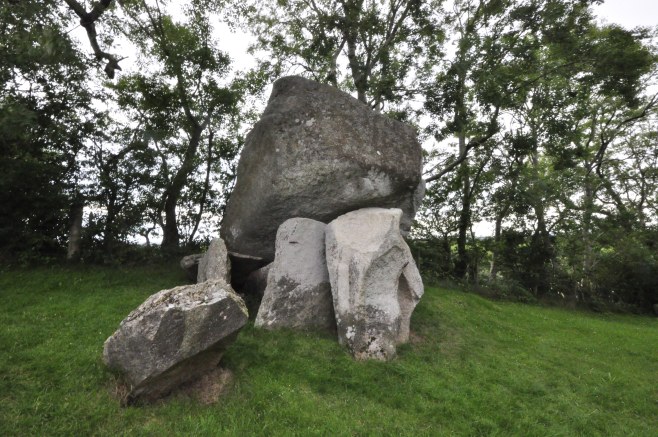
Pat Kearney’s Big Stone

‘A pilgrimage within a pilgrimage’

While approaching the end of my 680 kms cycling pilgrimage along the proposed Turas Columbanus I took time to make a mini pilgrimage to Goward Dolmen in the Parish of Clonduff, County Down.

The reason being my aunt Madge is married to Pete Kearney and they have lived in Mittagong New South Wales for many years. The Kearneys originally hailed from Goward, but there are no Kearneys living in the old parish now.

While cycling out of Hilltown in the rain recently I asked an elderly lady if she knew of Pat Kearney’s Stone and she gave me good directions. But she wasn’t aware of any Kearneys from the area. As I turned onto the laneway I could see that the furze bushes had been cut and the lane was littered with thorn branches. Between the rain and the thorns I decided not to venture the mile or so off route and planned to visit on my next leg of the journey.

On Tuesday I completed Turas Columbanus to Bangor and on my return via Hilltown, I drove to Pat Kearney’s Big Stone.

Pat Kearney's Big Stone
Pat Kearney’s Big Stone

Pete’s father, also Peter, carried out detailed research some years ago, along with his wife and established where their ancestors were from and he came across a photo of his great grandfather sitting on a ledge beside the big stone.

Petes’ brother Michael sitting alongside the Stone, recreating the photo of his Great Grandfather from 1850

The first member of the family to visit the Stone was Pete’s son, and our first cousin, Jason, who was sent on a mission by his Grandad to visit the Stone and take photos. Pete and members of his family subsequently visited the area some years back and completed walks from Kilbroney to the Stone thus honouring their ancestors and their home place. Pete just provided me with the following detail about the Kearney family of Goward and Pat Kearney’s Big Stone.