Rothar Routes

Cycle routes & pilgrim journeys in Ireland and Europe …..

Posts tagged ‘South Leinster Cycle Routes’

Rathanna Cycle Hub ?

Looking for a place to plan some nice cycle routes from? The tiny village of Rathanna would make a great cycle hub for south Carlow, south east Kilkenny and Wexford around the Blackstairs. Located between Borris and the Blackstairs Rathanna is perfectly positioned for exploring the Blackstairs Mountains, using tiny traffic free local roads, where time seems to stand still.

Equip yourself with the absolutely brilliant ‘Blackstairs, Mount Leinster & The Barrow Valley’ map produced by East West Mapping (they are based in Clonegal, and produce a series of maps ideal for hiking and cycling activities) and you will have the complete picture to create a multitude of scenic and historically interesting routes that will have you coming back for more.

The history of Ireland and all our local communities is bound up in the richness of our original Irish place names. Every townland, hill and river has a name that tells a story – it might relate to the landscape, to the people who lived there, historical events or ancient mythology. This part of Carlow is rich in heritage. The place names reveal long forgotten aspects of our past – monasteries, churches, battle sites, folklore… they still live on and these connect us with our past despite the angliscation of our country which deliberately mistranslated their original meaning. That’s a pet hate of mine; I hate to see modern housing estates adopting typically English names such as … Tudor Downs or other such pretentious nonsense, when we have so many meaningful options in our original names and heritage to choose from.

In an era of rapid globalisation, preserving local placenames helps maintain a connection to the past. They are not just markers on a map; they are living records of the Irish language, our history, and our identity. For those interested in genealogy, researching placenames can reveal ancestral links and provide a deeper understanding of family roots.

And economically, for tourism and cultural heritage, the meanings behind placenames can enhance visitors’ appreciation of the landscape. Many tourists are fascinated by the poetic and descriptive nature of Irish placenames, which add depth to the country’s storytelling tradition. This quiet part of Carlow has its own unique charms, just waiting to be explored.

This is a great route with plenty of climbing featuring breath taking scenery and a magnificent narrow strip of tarmac with a huge drop down the mountain side if you get too distracted by the views! I started out at the car park opposite St Fortcherns Church in Rathanna and beside Osbornes tiny pub (which also has a hostel attached), it’s a gentle start, gliding downhill to Jack Carrolls bridge over the Killedmond river and on to the ‘Bull Ring – a unique little pentagonal piece of ground shaped by the surrounding network of roads and from where the climb starts to gently rise. It rapidly becomes very steep approaching Tomduff Crossroads and the approach road to Mount Leinster. Use the excuse of taking in the views to take a break from the fairly savage gradient as you head up towards the famous Nine Stones and the Columbanus Bell which marks the starting point of Turas Columbanus, a pilgrimage route, linking Carlow and Bangor in County Down.

The Nine Stones is a very popular spot for Sunday drives and the short walk up Slievebawn or the more challenging road to the TV transmitter on top of Mount Leinster.

I was delighted to bump into Carlow’s finest dual player ever, Paddy Quirke, here at the Columbanus Bell; he was out with the family for some fresh air and a ramble. Naomh Eoin’s finest played Railway Cup with Leinster and was a dual All Star Replacement. He looks as fit as ever!

The views across the patchwork of green fields of County Carlow stretch out before you as far as the eye can see; it’s not a road for the feint hearted and it’s always important to be cautious when meeting a car as it can be quite daunting to an inexperienced driver. If the pace uphill to this point was tortoise like, the descent down past the Head of the River Burren was an adrenalin rush!

The source of the River Burren. I was once inspired by a tale of the great Gus Merne who walked from here to Carlow following the path of the Burren and I undertook it many years ago but didn’t quite get back to Carlow town by dark!

My favourite place name in Carlow is ‘Cúl na Sneachta’. Situated at the base of Mount Leinster, the road follows the contour of the hill around in a sweeping arc and I noticed a memorial stone I hadn’t seen before. I pulled hard on the brakes and made out the inscription s best I could and it said ‘Cathal Goulding’ but I couldn’t really make out the rest of it. I looked to up when I got home and it transpires it was erected in memory of Republican, Cathal Goulding (1923-1998) who was ‘Chief of Staff’ of the IRA and the ‘Officials’. I hadn’t heard of his connection with the area but he had spent a lot of time in his cottage at Raheenleigh. Following his death, he was cremated and his ashes were scattered at the Nine Stones. You learn something new every day!

A bit further on I turned back left in the direction of Rathanna at a cross roads, where there’s a famous piece of rock art on display in the garden of a house at the cross roads. From there I headed up onto what I dubbed ‘The Hidden Sky Road’ some years ago and which Carlow County Council signposted as a local cycling route. I love this road that skirts the western side of Tomduff, towering over Rathnageeragh Castle and the former National School. I don’t think I’ve ever encountered a car on this road – nor another bike either!

Rathnageeragh NS in ruins, I took this a good few years ago.

Now transformed!

It was another downhill by Seskinamadra – Seisceann na Madraí, the marsh of the dogs… where I swung right and stopped over to visit St Fortcherns Well and Killoughternane Church ruins.

Despite it association with miraculous cures, I wasn’t tempted to have a ‘cuppa’ but clearly, other brave souls do and if the presence of frogspawn is an indicator of clean water, then I’m sure it would have done me no harm at all! A famous chalice and patten were discovered here that date back to 1595; they were hidden during penal times. There’s great reading about the history of the well and the area in the Myshall and Drumphea parish website.

Killougternane Church is a beautiful example of an early ChristianChurch dating back to the 10th century. It’s a beautiful serene place to visit and the stone work is immaculate.

Also known as ‘The White Church’, this 10th century granite church is built on the remains of an earlier timber church founded by St Fortchen in the 5th Century. Local wisdom holds that Christianity was established here even before the arrival of St Patrick. Who knows for sure.. ‘Cill Uachtair Fhionáin’ meaning the ‘upper church of Finnian’ highlights its connection with St Finnian of Clonard (but really of Myshall!), one of the greatest monastic sites in the country where the ‘Irish Apostles’ were all educated.

I skirted around by Knocksquire and traced my way back to Rathanna via Killedmond after a terrific afternoon cycle, sightseeing and exploring our local heritage. Good to be able to do it!

Taking the Long Way Around

There’s more than 60,000 unique Townlands in Ireland, that stretch back to the Middle Ages or before. They remain the basis of rural addresses and provide a sense of identity. No where else in Europe has preserved their place names. Loyalty to the home place is so strong in Ireland, stretching back thousands of years – look at the rivalries between the tiniest of clubs! Most of these names were originally in our native tongue but were transposed into English after the Act of Union. Here’s the names of some of the Townlands I cycled through yesterday:

The Irish version of the names usually provides a clue as to the location – many names will include the likes of ‘Carraig’, Dún’, ‘Rath’ etc.

The Long Way Around

South Carlow is an area of outstanding natural beauty, it doesn’t attract big numbers of tourists but those that do stray in tend to like what they see and return again! I met a surprisingly big family group in Rathanna, probably staying in Osbornes Storehouse. The route I took is mainly in local roads with a few stretches of rough lanes and with plenty of hills – over 850 metres of climbing in 55kms. I must have crossed the disused route of the old railway line from Bagenalstown to Palas East four or five times; there are some beautiful bridges and it’s lovely to see the old station house at Ballyling beautifully refurbished since I last took a photo of it.

An area of outstanding natural beauty, bordered by the River Barrow on the West and the Blackstairs Mountains on the East. There are numerous heritage sites all over south Carlow with many great examples of rock art, which I’ve covered previously. Today was about fresh air and exercise – even if it was assisted…

River at Rosdelllig

I presume this warning is an old sign associated with the railway line. Saw this near Dranagh.

On the Trail of Saints, Kings & Vikings

The source of the Wren Boys tradition is lost in the mists of time and while I wasn’t partaking in any hunting of the wren on this St Stephens Day, I came across a few on my fantastic cycle today along the Nurney Plateau. The road up through Nurney across by Augha gives beautiful views of the Barrow Valley but also access to some great lesser known heritage sites of County Carlow.

I love the climb up to the highest point above Nurney village, its only 226 metres but it’s a good pull rewarded by views of the Wicklow Mountains to the east, the Blackstairs to the south, across the Barrow Valley and up onto the Killeshin Hills in the west, with Carlow Town spread out to the north. I sped down into Newtown and swung right towards the townland of Kildrenagh. There’s a well hidden large head of an old cross and a stoup, or holy well, located in a hedge along a cul de sac. If you didn’t know it was there you would never find it.

Kildrenagh Cross and Stoup.

The Dúchas website is an amazing anthology of folklore collected by school children in National Schools during the 1930s. Here are two stories written by a Joseph Mahon of Augha and a May O Brien of Ballybromell, Fenagh.They make lovely reading as the following extracts show about this site and Augha Church which was my next stopping off point.

Kildrenagh (Cill Droighneach) means The Church of The Blackthorn or Sloe Bush and there are remains of a monastic site and bullaun stones in the fields alongside the road dating back to the 2nd Century BC. The Celtic Cross is 10th or 11th Century and you can see the outline of carvings of a Christ figure in the central panel with various crucifixion symbols on the side panels, a ladder, nails, hammer. They were uncovered in the early 1800s by workmen laying a road for Captain Bruen of Oak Park to link Newtown with Ballywilliamroe Bog. They reerected them on the opposite side of the road to where they were discovered.

I love visiting this well which supposedly has the cure for warts. Time to keep moving and it was on then in the direction of Dunleckney – another interesting place to visit, but this time I turned in the direction of Augha. The 7th Century Church ruins at Augha are considered among the most beautiful pre-Romanesque architecture in Ireland. It’s amazing to see how the granite stones are so uniform in size and shape.

The Vikings paid it a visit in 866 and did their usual plundering and pillage…!

At Augha Church.

It was time to head for home now and I retraced my route from Nurney back towards Tinryland but first stopping off to visit Ballyloo Castle, built in 1390 by Art Óg Cavanagh, King of Leinster who was poisoned in 1417! Isn’t it amazing the history that is around us in plain sight but which we can’t see? The Castle ruin is barely visible as it has become overgrown with ivy. It is another important part of our heritage. All three sites today are in need of protecting or they will sadly crumble into heaps of stones in the next 50/100 years. And there will be no markers to our past.

It was a perfect day for a cycle, on lovely quiet scenic rural roads of the hidden Carlow. Well worth taking time to explore these historic sites!

2021 – a great year for the bike!

What a year of joy, cycling north, south, east and west of this beautiful island!

Approaching the finish of Malin to Mizen

I’ve said it before but we have an unbelievable network of local roads suitable for riding bikes, whether it be an hour loop or a long distance tour. The beauty of the local roads is that it takes you into the heart of rural Ireland, into small villages and off the beaten track. Virtually traffic free the roads are super safe. As rural Ireland declines, eco tourism offers a mountain of possibilities and the growth of hiking trails and bike routes will aid in the promotion of local areas and perhaps keeping them populated with increased economic activity associated with sustainable tourism. With Covid concerns in 2021, we really enjoyed avoiding the ‘tourist hotspots’ over the year and travelling the road less travelled; people have more time to be friendly and it has a more authentic feel to it.

The Blackstairs Mountains, County Carlow

There’s massive potential for off road touring too if routes can be accessed and developed. Any route development needs to be minimal; in most cases all that is needed is some annual maintenance and good signposting.

Ballycarney, Co Wexford
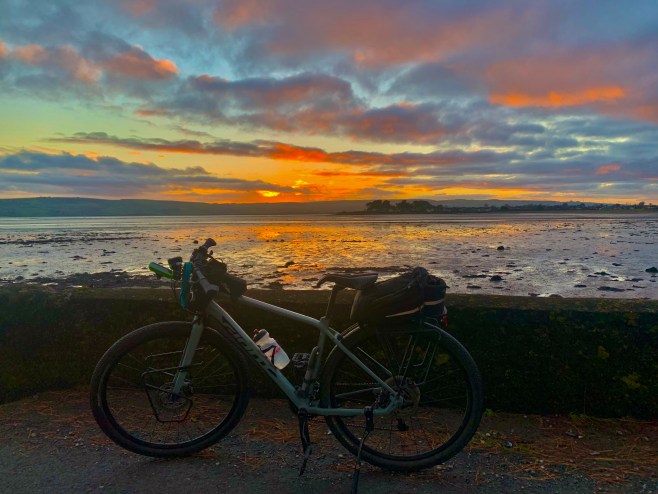
Sunset Dungarvan Harbour

It’s taken me a while to come to the realisation that a Greenway is definitely not designed as a cycle route. At this stage I’ve now cycled on all the Greenways across the country:

  • Great Western Greenway, Mayo, 42kms
  • Waterford Greenway, 46kms
  • Old Rail Trail, Westmeath, 42kms
  • Royal Canal Greenway, Longford to Dublin, 130kms
  • Suir Blueway, Tipperary, 21kms

My experience on the Greenways is that the routes are used more by walkers than cyclists and by families with young children. Consequently most of the activity is typically in the 5 kms close to the hub points, with the mid sections very quiet. As most of them follow the path of old railway tracks they tend to be very straight and boring after a few kilometres. While there is stunning scenery on the Western Greenway and the Waterford Greenway, most of the routes are enclosed by the old banks that bordered the railway line or hedging. I find them a bit soulless and sterile and much prefer the local roads that twist and turn offer up interesting heritage sites and beautiful views. The Greenways are great additions to an area but for cycle touring I would tend to probably avoid them unless they linked specific places I needed to get to.

Gougane Barra, West Cork
Free Derry Corner, The Bogside, Derry en route from Malin Head to Mizen Head

The majority of our cycling is of course locally and we have got into the habit of cycling all year round. Night cycles on cold winter nights are exhilarating and we have so familiar with our favourite routes close to Carlow Town that the bikes almost steer themselves!

Night cycle on the River Barrow
Heat Map of our cycle routes

We covered a lot of ground in 2021, most of it local but looking at the heat map, we are only scratching the surface of places to see and visit in the years ahead!. Roll on 2022.

How now brown cow?
Training run before Malin to Mizen
Barley Cove, West Cork

The Greenway for south Carlow?

When all the controversy over the proposed Blueway, which was refused by An Bord Pleanála, was in full flow, many of us expressed legitimate concerns about the conversion of the national way marked hiking route, that is the Barrow Way into a hard surface. The Barrow Way is the Irish Trail with the least amount of road walking, as confirmed by the great walking couple, Ellie and Carl who run a fantastic YouTube channel dedicated to trail walking in Ireland.

This Irish Times report may be a game changer for the Carlow route and would give us the best of both worlds – our own greenway through the nicest part of Carlow and retains our walking route along the narrow green corridor of the Barrow Valley, thus protecting its biodiversity, its grass surface, its multi purpose use and its status as an area of special conservation.