Rothar Routes

Cycle routes & pilgrim journeys in Ireland and Europe …..

Posts tagged ‘Lough derg’

Moylussa – Clare’s Highest Point & Best Views over Lough Derg!

County Clare is often associated with the limestone pavements of the Burren or the towering Cliffs of Moher, but its highest point lies further inland in East Clare – the hurling heartlands, looking down on the broad waters of Lough Derg. Moylussa (532m) rises out of the Slieve Bearnagh range, overlooking Killaloe and Ballina, the twin towns that straddle the Shannon. Today I ticked off Clare’s summit – my 25th County High Point out of 32 – and it turned into a walk of woods, bog, lakes, history, and a little bit of hurling talk thrown in! The views over Lough Derg, Killaloe and Ballina are just stunning on a fine day like today.

Encounters on the Mountain

I thought I was doing well until I was overtaken on the way down by a Limerick man in his seventies, running the descent with ease! We’d shared a great chat at the summit about Limerick hurling – he turned out to be a fellow clubman of Tom and Dan Morrissey from Ahane. Proof, if ever needed, that hill fitness isn’t always a young person’s game!

On the way up, I also passed a touching shrine adorning some trees, a personal memorial lovingly kept. It felt fitting – these mountains, though not crowded, carry people’s stories as much as their summits carry views.

Mountain Goat!

Moylussa in History and Lore

The mountain is part of the Slieve Bernagh (Sliabh Bearna) range, meaning the “Mountains of the Gap.” These uplands acted as a natural barrier in medieval times, forming a wild border between the kingdoms of Thomond and Ormond.

Killaloe itself, nestled at Moylussa’s foot, is steeped in history. In the 10th century it was home to Brian Boru, High King of Ireland, who ruled from his fort at Kincora overlooking the Shannon. Standing on Moylussa’s summit, you can almost imagine his longboats drawn up on the waters below.

As for myth, the Shannon itself is tied to legend: the river is named after Sionann, granddaughter of the sea-god Lir, who is said to have drowned after tasting the waters of Connla’s Well in search of wisdom. From high on Moylussa, where the Shannon spreads into Lough Derg, the story feels close.

In more recent times Irish rugby stars Keith Wood and the late Anthony ‘Axel’ Foley are among Killaloe’s most favoured sons!

Weather, Luck and County High Point #25

The forecast had threatened showers, but apart from a few early drops the rain held off until I was safely back down. Sometimes the mountain gods grant a little mercy. With Clare’s high point now under the belt, that’s 25 of 32 climbed – the end of the challenge is starting to come into view.

Moylussa might lack the rugged cliffs or dramatic peaks of some counties, but it rewards with atmosphere, wide horizons, and a sense of standing at the heart of Ireland, looking out over river, lake and history.

  • County Clare High Point
  • Height: 532 metres
  • Starting Point: Ballycuggaran Car Park
  • Distance: 10kms out and back
  • Ascent: 450 metres
  • Moving Time: 1 hour 43 minutes
  • Terrain: Forest Trails, some slippy rocky sections, bogland boardwalk (no walking permitted on the bog)
  • Difficulty: Moderate – steep start and rocky sections tricky on the descent
  • Highlights: Has to be the view of Lough Derg and Silvermines Mountains

Inis Cealtra – Holy Island

Holy Island Round Tower and St Colum’s Church

Plenty is known about the main pilgrimage routes and sites across Europe and, closer to home, about such places as Croagh Patrick and Lough Derg, Co. Donegal. Pilgrimage to these major shrines and places was usually a once in a life time undertaking which very few of the ordinary people of the country could not contemplate.

But there were many other sites, which were more local in nature that filled a yearning in people for hundreds of years. Inis Cealtra, aka Holy Island is on Lough Derg in County Clare (though once part of County Galway) and it’s a beautiful place to visit.

St Brigids Church

There is little recording of the act of pilgrimage in Ireland apart from some historical references in the Annals to the death of someone on pilgrimage in Ireland. Seamus Heaney accounted for this best when he talks about ‘peasant pilgrimage’ – the goings on of the ordinary person about their daily lives. Going on pilgrimage and retreats was very much a feature of Irish life that did not get recorded, yet was a very important part of living. When you visit a place like Holy Island, you can feel the importance of the place as you as you set foot on it. Holy Island is one such place.

Access to Holy Island is by boat and no better man that Gerard Madden to ferry you across

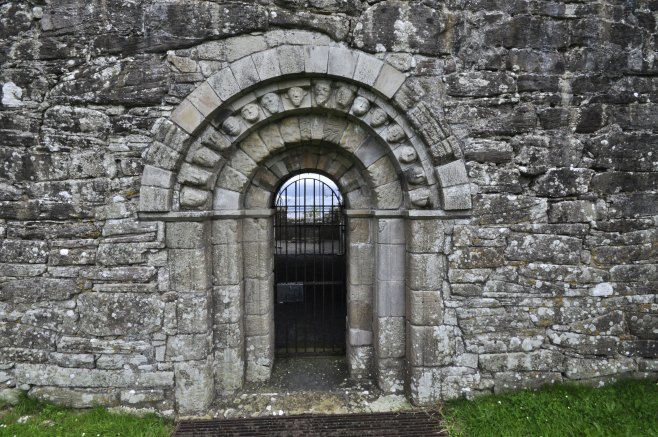
The island consists of approximately 18 hectares and is accessed by boat from Mountshannon, a pretty little village on the western edge of Lough Derg. There are extensive monastic ruins, including a Round Tower and a number of small Churches – St Caimin’s, St. Colum’s, St Michael’s, St. Mary’s and St. Brigid’s. The monastery was originally founded by St Colum around the year 520 AD.. He is often referred to St. Colm of Terryglass, which is on the other side of the Lake. He was a pupil of St Finian of Clonard – who was originally from Myshall.

The monastery though is mainly associated with St. Caimin who is still revered in east Clare. According to the Annals of the Four Masters, his mother, Cumman had 77 children! One of the stories about Caimin, concerns a meeting he had on the island with his half brothers Guaire Aidhne, and Cummine Fota where they talked about what each wished the Church to be filled with. Guaire hoped for it be filled with gold and silver so that he could be generous to the poor, Cummine hoped for it to be filled with books so that students could learn but Caimin wished for the church to be filled with evert conceivable sickness so that all these diseases could be inflicted on his own body. All three wishes were fulfilled, Guaire got wealth, Cummine learning and Caimin was inflicted with illness!

Holy Island

There are a number of important artefacts on the island among them a Holy Well, also called ‘Lady’s Well’; the Bargaining Stone, where deals were sealed by shaking hands through the hole underneath the stone; some bullaun stones and some important cross decorated stones in the Saints Graveyard.

‘The Confessional’, one of the unique buildings on the Island – was it a hermits cell?
Holy Island Video

It’s a shame we don’t have better historical records as many of the monks who lived in these monasteries went on to be major historical figures in Europe and in the history of the Church. One such monk was Donatus. He was educated here and later travelled to Italy where he became Bishop of Fiesole. Margaret Stokes wrote extensively about the Irish Saints in Italy in her book ‘ Six Months in the Appenines: Or a Pilgrimage in Search of the Vestiges of The Irish Saints in Italy’. Donatus travelled with Andrew the brother of St Brigid. All three have links with Italy. I was fortunate to spend a little time in the area a couple of years ago and sought out these links. It was very rewarding!

Tomb of St. Donatus in Cathedral of Fiesole
St. Brigid’s Cave under the Church in the village of Santa Brigida, north of Fiesole.
St. Brigid’s Church, Holy Island

The Vikings of course visited here too and, led by Tugesius, plundered the monastery before going on to inflict more carnage on Clonmacnoise, further up the river. The island is also associated with Brian Ború, High King of Ireland and the man who got rid of the Vikings for good in 1014 at the Battle of Clontarf. And I might add his son Turlough O Brien, King of Munster, buried his wife Gormlaith on Holy Island in 1076!

WB Yeats wrote about pilgrimage on the island in his poem ‘The Pilgrim’:

I fasted for some forty days on bread and buttermilk,
For passing round the bottle with girls in rags or silk,

In country shawl or Paris cloak, had put my wits astray,
And what’s the good of women, for all that they can say
Is fol de rol de rolly O.

Round Lough Derg’s holy island I went upon the stones,
I prayed at all the Stations upon my marrow-bones,
And there I found an old man, and though, I prayed all day
And that old man beside me, nothing would he say
But fol de rol de rolly O.

All know that all the dead in the world about that place are stuck,
And that should mother seek her son she’d have but little luck
Because the fires of purgatory have ate their shapes away;
I swear to God I questioned them, and all they had to say
Was fol de rol de rolly O.
A great black ragged bird appeared when I was in the boat;
Some twenty feet from tip to tip had it stretched rightly out,
With flopping and with flapping it made a great display,
But I never stopped to question, what could the boatman say
But fol de rol de rolly O.
Now I am in the public-house and lean upon the wall,
So come in rags or come in silk, in cloak or country shawl,
And come with learned lovers or with what men you may,
For I can put the whole lot down, and all I have to say
Is fol de rol de rolly O.