Rothar Routes

Cycle routes & pilgrim journeys in Ireland and Europe …..

Posts tagged ‘River Shannon’

Greenland Is Ours, JD Vance! – Ireland reclaims its Overseas Territories!

Yesterday, standing beside the ancient grave of Saint Brendan in Clonfert, I felt something stir—not just reverence, but revelation! As the wind moved through the trees and the moss-covered stones whispered of old voyages, it struck me with divine clarity: Greenland—and quite possibly all of North America—rightfully belongs to Ireland. Not through war or treaty, but through Brendan, who almost certainly discovered it a good 900 years before Columbus, and did so without enslaving anyone, planting flags, or raiding their gold and silver mines. And if that truth unsettles certain American senators with a penchant for lecturing the world, well… that’s just a bonus. We got there first but we were too humble to tell anyone!

According to the Navigatio Sancti Brendani, Saint Brendan and a group of monks sailed west in search of the “The Isle of the Blessed”—an allegorical tale filled with sea monsters, magical islands, and flaming mountains. Some people, especially in modern times, have speculated that this was actually a description of a transatlantic voyage, possibly to North America. It’s no accident he is patron saint of the U.S. Navy! Tim Severin’s 1970s expedition in a replica leather boat (The Brendan Voyage) showed such a journey was physically possible, using medieval technology. He successfully sailed from Ireland to Newfoundland via the Hebrides, Faroe Islands, Iceland, and Greenland. So hands off JD Vance, we’re laying claim to those rare minerals!

Joking aside, we’d a great cycle yesterday starting in Banagher and heading over to Clonfert along quiet country lanes. The ancient Romanesque doorway is a sight to behold with its intricate carvings. Clonfert Cathedral, in the tiny quiet village of Clonfert, County Galway, is a true gem of Irish history dating back to the 6th century. Founded by St. Brendan, it stands as a testament to ancient ecclesiastical prominence.

The beautiful round arched west doorway at Clonfert Cathedral is a lovely relic of Irish Romanesque decorative architecture built A.D. 563. Monasteries flourished as centres of learning and sent missionaries to many European countries, bringing with them the classical literature of Greece and Rome. Reports in the 9th century suggested that anyone who spoke Greek on the continent was an Irish person or had been taught by an Irish person. Truly, the Land of Saints and Scholars!

Clonfert Cathedral
Clonfert Romanesque Doorway

Places like Clonfert helped preserve Irish Catholic Identity after the Cromwellian Conquest of Ireland,. immortalised in the awful phrase “To hell or to Connacht”. This was one of the most brutal and traumatic periods in Irish history with ten of thousands of Irish displaced from their home and something like 11 million acres of lands were confiscated from Catholics – by the end of the 1650’s 90% of the land was in Protestant hands. It was a form of ethnic and cultural cleansing that did untold damage to the Irish language.

We weren’t long before we were cycling past Brackloon Castle, one of Ireland’s oldest and smallest castles, now restored and lived in! Built in the 1500s by the O Madden Family, who too were dispossessed by the English… While St Brendan set sail west in search of heavenly peace but instead discovered America, Cromwell followed up a 1,000 years later sending our ancestors west into Connacht in search of survival. If Brendan discovered America, Cromwell helped us populate it with wave after wave or Irish migration! ICE are at the airports today to make sure no more get to follow ‘the American Dream’… mind you there’s many a Yank yearning for travel in the opposite direction today!

Meelick Church was the next stopping off point, reputedly the oldest church still in use in Ireland today! Meelick weir is a stone’s throw away, if you’re good at throwing stones and it’s a beautiful 300 metre curved walkway / cycleway. It’s part of the Hymany Way and the Beara-Breifne Way which we followed a few years ago on our Malin to Mizen cycle. I love coming down here!

Meelick weir walkway on the Shannon.

This links to an island in the Shannon river and Victoria Lock, which was constructed in the 1840s. Really picturesque views on it with the roar of the water deafening beneath you. A great place for a picnic!

Victoria Lock looking northwards
Victoria Lock
The River Shannon south of Victoria Lock.

Bikes can easily be walked across the Lock and that brings you into a lovely route close to the Shannon Callows – a great place to do some bird watching and a nice easy loop back though Lusmagh to Banagher.

You could say the landscape is flat and boring but there’s beauty in that too and there’s a real touch of the west of Ireland as soon as you cross the Shannon at Banagher. Worth noting too that the 3 provinces of Munster, Connacht and Leinster meet right here at this point on Victoria Lock!

Cycling through the countryside while mentally travelling through the centuries, wondering if St Brendan had quads like these! Another great day in the saddle!

Hidden Heartlands

Where three Provinces meet – Galway (Connaught), Offaly (Leinster) and Tipperary (Munster)..

Cycling allows me to drift out of this modern world, to find connections with the past and revel in the beauty of the ordinary. Each time I manage to wind down the beautiful network of bóithríns that form a web across this land I sense adventure behind every bend of the road. Reminders of the past are everywhere; the importance of place and person. As I glided by the ruins of a gable end I spotted a plaque to commemorate Pat Madden, Captain of the Meelick team that represented Galway against Thurles of Tipperary in the first All Ireland Hurling Final, played in Birr on April 1st 1888. The little gems I spot on my bike bring connect me to another time.. the name Madden in these parts goes back a long way..was Pat a descendant of the Maddens who ruled this part of the country in the 1600s and lived nearby in Brackloon Castle – which is still lived in today?

Long gone but not forgotten …Pat Madden,
Captain of Galway in the first All Ireland Hurling Final

I passed through this area twice in recent years, once on a boat heading for a choppy Lough Derg (thought we were going to capsize!) and once cycling from Malin Head to Mizen Head. I promised myself I’d come back and explore this hidden, under stated part of Ireland. I wasn’t disappointed. Rivers are among the oldest paths used by man; armies have criss crossed over these crossing points, monks founded monasteries and churches nearby, communities grew up around them. There are reminders of a storied past, be it in churches, castles, bog roads and bóithríns. It’s hard not to follow any semblance of an off road path and today’s cycle finished with a lovely loop around Lusmagh Bog. Early maps of Ireland show tiny Banagher, Clonfert and Meelick (much more significant places in the distant past than now).. and a mile of land planted with soldiers under the Cromwellian Act of Settlement 1652 when the Irish were banished ‘to Hell or to Connaught’…..

The busiest house builders in the country, na préacháin, were out in force; there was a soundtrack overhead of hundreds of crows flying back and forth with twigs to build their lofty nests. All around me was a liquid landscape – the Shannon Callows stretch east and west and are home to many migrating birds including the endangered corncrake. I’d love to have heard one call but I think they only call after dark… on another visit maybe. A mink stuck his long sleek body out of a hedgerow, paused as he saw me approach and was gone in the blinking of my eye.

Cycling along these empty country lanes is miraculous; transporting me to another world with every turn of the pedals, something that cannot be felt in a metal box on four wheels… free to wander, look over a ditch, unworried about traffic. I have become accustomed to knowing what type of vehicle is behind me and how it is being driven, how safe I am, whether I need to pull in off the road. There is an Arabic saying that ‘the soul travels at the speed of a camel’ Biking too is slow travel. It feels so calm and natural.. a perfect union of man and machine…the only sounds are bird song and the turning of the chain ring. And I can’t forget the smells. I could smell the turf burning in the firesides – winter isn’t fully gone yet and there’s plenty of cheap turf in these parts. Cycling is how I best feel the geography of this island, the low-lying midland plains and the mountainous rim of our coastal counties and our central uplands.

Meelick Weir Walkway

St Brendan the Navigator, known all over the world for the famous medieval saga of The Voyage of St Brendan – on returning from his epic voyages (replicated by the great Tim Severin the 1970s, who proved it was possible that he had crossed the Atlantic before Columbus!) founded a convent in Annaghdown. He later was given the site at Clonfert where he founded his famous monastery. It became a great seat of learning and it’s estimated there were 3,000 monks here in its heyday. The Vikings often raided Clonfert and it was burnt to the ground on three occasions. Gradually Vikings integrated with the native Irish and it is telling that the stonemasons who rebuilt the doorway integrated Viking images of animals in their sculptures.

I stumbled on a unique burial tradition here in Clonfert, where graves are lined with chicken wire and branches of laurel are woven into the wire to provide a beautiful resting place for the deceased. I was delighted to see this being done while I was being regaled with the true tale of the incredible 9 legged cycle! Anthony Flanagan lost his leg many years ago in a combine harvester accident. He didn’t allow it define him or inhibit him and he undertook a credible charity cycle a couple of years ago along with 4 others. With just ONE LEG he completed a 420km cycle IN 24 HOURS for some local causes. The following year they cycled to Croagh Patrick AND HE CLIMBED IT! I came out of Clonfert graveyard with my head spinning, full of amazement at the spirit of Anthony and his absolute determination to get on with life regardless of the cruel hand he was dealt. I salute him. You can hear the great man himself in this video clip:

Pilgrimage in Ireland goes back into the depths of time. There was competition between sites of pilgrimage and it was no harm for a location to have an association with a saint or two. Churches often held reliquaries with remains of particular holy men a major attraction. Two saints, Moinnean and Cummins Fadahad had their remains removed from Lann Eli, Offaly (Lynally?) and they were placed in a shrine that was brought to Clonfert but which has long since been lost. A fragment of a shrine though was recently discovered in Clonfert but not enough detail to confirm it was the original shrine holding the remains of the two holy men. Holy Trees were and are still another important place of pilgrimage. Saint Brendan’s tree is located adjacent to the Cathedral and it is covered in offerings, brought by people looking for intercession on behalf of an ill relative or for other reasons. There is a statue of 13th/14th century statue of the Madonna and child in Clonfert Catholic Church which is the focus of a month long pilgrimage in parish of Eyrecourt, Meelick, Clonfert. These ties with places and objects are hundreds of years in existence and showing no sign of a drop off in interest.

This is the route Map of the way I went. Part of it incorporates the Hymany Way and the Beara- Breifne Way, both well worth exploring on foot or by bike.

Victoria Lock

Shannon Callows and Lusmagh

The One
Written by Patrick Kavanagh

Green, blue, yellow and red –
God is down in the swamps and marshes
Sensational as April and almost incred-
ible the flowering of our catharsis.
A humble scene in a backward place
Where no one important ever looked
The raving flowers looked up in the face
Of the One and the Endless, the Mind that has baulked
The profoundest of mortals. A primrose, a violet,
A violent wild iris – but mostly anonymous performers
Yet an important occasion as the Muse at her toilet
Prepared to inform the local farmers
That beautiful, beautiful, beautiful God
Was breathing His love by a cut-away bog.

Coast to Coast Day 5

I passed the half way point yesterday somewhere near Lough Talt, so I was feeling good this morning knowing that today would eat another big chunk off the second half of the challenge.

Boyle is a great base to explore a region that is very underrated. There’s loads to see and do around here; the only problem is there’s not much accommodation in the town.

Boyle or bust…

Getting our of Boyle was great – my route took me through Lough Key Forest Park, a place I have fond memories of from a training camp with Mary, Patricia & a bunch of their international team training group. Lough Key is on the edge of the Town and its a gem. Full of beautiful woodland and lakeside walks and activities. A really nice place. Lovely route through for me that took me onto the back roads of lovely Leitrim.

Passed this lovely and unusual octagonal house just after Lough Key Forest Park. Took a left here.

I’m going back to Leitrim at some stage. I like this county. Small. Understated. Beautiful. Quiet. Rural. Not flat – lots of small hills, I was moving into drumlin country. Some wise man described drumlins as akin to half buried eggs and he was right! Up and down, up and down and though not very high, the gradients could be challenging! The early part around the Shannon was nice and flat and beautiful surfaces for biking. Shortly after crossing the Shannon at Battle Bridge I rolled into Leitrim village the gateway to the Shannon Erne Waterway and is a popular stopping off point for cruisers.

The county is very sparsely populated and while I was travelling the back roads, it was even more isolated than expected. I had one 57kms stretch before I came to a shop!

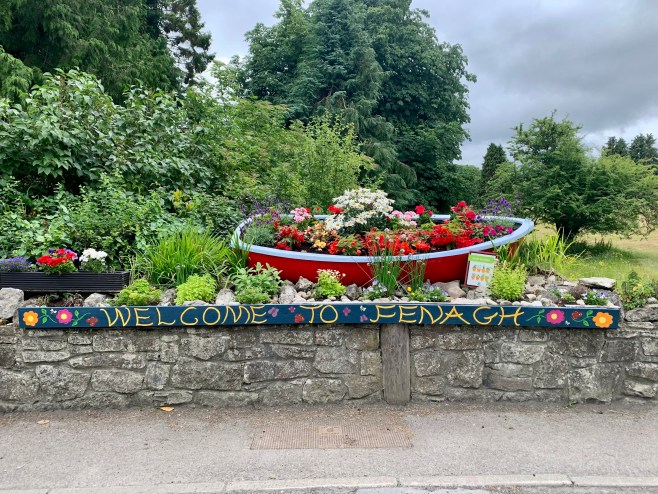
Would the real Fenagh please stand up! We have our own lovely Fenagh village in the centre of Carlow and Leitrim has one too. Even smaller than our one! Its located close to the River Shannon and it wasn’t long before I reached a jetty near Keshcarrigan where I had a great chat with a guy cruising up to Enniskillen who was also a keen cyclist.

Between every drumlin there must be a lake! The route I took brought past so many pristine lakes, too many to have names! It really is beautiful biking country. But the hills are relentless, especially with full panniers. I broke at Carrigallen and had a well earned sambo.

If the hills in Leitrim were a challenge Cavan literally topped them! My elevation graph is like a printout of an ECG… and I thought I might need one of those when I got into Cavan! A bustling town, another place I have good memories of games in Breiffni Park. I though I would have no difficulty in getting a room in town but it bursting at the seams and I was lucky to get one in the Kilmore Hotel. It was my earliest finish yet to a days cycling which I was glad of.

Hands off Creature!
Back roads video clip

‘That bates Banagher”

I never in my wildest dreams imagined spending two nights of my holidays in Banagher! If there is a positive to Covid-19 it is that we are looking afresh at how we spend our time and where we spend it.

Growing their own grapes on Main Street Banagher!

#Staycation is the new buzzword and holiday at home is the only recommended option. Avoiding Covid hotspots and crowded venues should be the norm if we are to restrict the spread of Covid.

On the plus side we are looking at our own country in a different way; we are seeing the beauty in the ordinary and loving it. We spent the last week exploring Ireland’s Hidden Heartlands and its Ancient East – never quite sure where the demarcation line is between the two!

The Mighty Shannon

One thing for sure is that the welcome is genuine, there is nothing ‘fake’ about the friendliness of people that you meet, which sometimes I question when I visit tourist hotspots along our coasts.

It was our first time to hire a boat and my only regret is we didn’t do it years ago! It was the perfect way to social distance and to see places along the Shannon from a different perspective. Time stands still as the boat moves so slowly! Great to see groups of young people thinking likewise and hiring small boats and barges for a holiday with a difference – they don’t deserve the blame they are getting for the increase in the spread of Covid – they are no more responsible than every age group..

Stopping off in tiny villages such as Dromineer and Terryglass was just perfect; some great local pubs with great food, great walking and cycling routes too.

Lough Derg
Walking Slí Eala near Dromineer

The Shannon region is steeped in history and there are some amazing sites to visit. Is there a more scenic setting for a monastic site than famed Clonmacnoise? The English and the Vikings have a lot to answer for in relation to our heritage sites. They reduced so many of them to ruins and destroyed such important parts of our history.

Temple Ciarán, reputed burial place of St Ciarán who founded the monastery in 548 AD.
The beautifully carved South Cross with the Cross of the Scriptures and the Round Tower behind.

Not far away along the byroads of Offaly is Lough Boora Discovery Park and The Offaly Way where we got to take in some lovely cycling routes across a corner of Offaly I’ve seldom visited.

Lough Boora Discovery Park

West of the Shannon, Portumna Forest Park covers an impressive 1600 acres and has some incredible single trail cycle tracks. Home to a herd of fallow deer and its possible to spot the White Tailed Sea Eagle from the bird hide on the Lakeshore.

20kms of single track
Turloughs are disappearing lakes found in limestone areas west of The Shannon
This is a Turlough! A disappearing lake, common in limestone areas especially west of the Shannon.
Portumna Pier

One of the highlights of our trip was a visit to the stunningly beautiful and simple Meelick Church – the oldest church in continuous use in Ireland, Built in 1414 AD it is still in daily use.

In continuous use since 1414 AD, the oldest Church in continuous use in Ireland
Meelick Church, founded by the Franciscans in 1414 AD.
Meelick Church

Seven days exploring a region that we would normally pass through proves yet again that every county has so much to offer, if we only take the time to visit and explore. Look with new eyes, try something different, use your two feet and explore the great outdoors! We give out about the weather but in reality there is no such thing as bad weather only bad clothing! Stay home this year, spend a few bob in our own country and help small businesses stay afloat and hopefully thrive!