The Dartry mountains, featuring famed Ben Bulben and its magnificent table top plateau, tower over Sligo and are one of the most stunning mountain ranges in Ireland. Truskmore is the highest point in the range and the walk to the summit, along the access road to the TV transmitter provides stunning views to the north out past Lissadell House, Mullaghmore, across Donegal Bay and Slieve League in the distance.
Looking west, Knocknarea towers over Sligo Town and Glencar Lake. Incredible views all round – if you get a break in the clouds and from the rain! The access road is located on the Gleniff Horseshoe Loop Drive. It involves climbing over the locked gate – well designed to enable an easy climb over!.
The access road provides a relatively easy walking route to the top. I parked close to the gate but out of the way of access and there isn’t much room for more than a couple of cars to park here. The zig zag access road is quite steep for long stretches, gradient averaging 10% – and a few rests help to catch the breath! The weather was quite rough, with very high winds, some rain and sleet and it wasn’t long before the mountain was shrouded in mist. Navigation wasn’t a problem, apart from the short section across the wet boggy area to make it to the Leitrim High Pint of 631 metres. The Sligo high point is located beside the mast and is slightly higher at 647 metres. A map is an essential requirement on hill walks as conditions can change rapidly and its so easy lose all sense of direction.
This was especially through when searching for the Leitrim High Point as it is located right on the edge of a very steep cliff face – if the wind had been from the north, it could easily have blown us off course and over the edge!
I was delighted to make this unplanned trip to take in these two High Points, making it 20 County High Points now completed. This climb would be a terrific one to do on a fine day as the views are outstanding. Counties Sligo and Leitrim are two of my favourites, neither are quite mainstream tourism but they both have an abundance of scenic mountain, lake and sea views plus a high number of heritage sites.Other laces worth visiting aer Carrowkeel, Knocknarea, Caves of Keash, Glencar Waterfall and the Devil’s Chimney!
Tombstone of WB Yeats at Drumcliff.
A word of caution while walking in this area; access may not always be possible across private lands and needs to be checked out in advance. Eagerly looking forward to my next County High point!
The Shannon. Ireland’s largest river, at a magnificent 360kms, comes bubbling out of the ground close to the border between Cavan and Fermanagh in the Cuilcagh Mountains, at a place quaintly called The Shannon Pot or Log na Sionna as Gaeilge “The Hollow of the Shannon”. It’s a large pool of golden brown water about 16 metres in diameter and at least 9 metres deep. The water reaches the Pot through a network of underground streams and many say that it actually starts in County Fermanagh at a place called the Pigeon Pot. An experiment saw some green dye poured into the Pigeon Pot and observing that it eventually travelled underground to reach the Shannon Pot! In truth there are probably multiple streams feeding into it. This area is full of extensive cave networks and Marble Arch Caves, on the other side of the Mountain, are worth a visit.
Rivers and streams play important roles in Irish mythology as a boundary between this World and the Otherworld. Almost all Irish Rivers bear names associated with the Goddesses of the mysterious Tuatha Dé Danann. And so it came to pass that The Shannon was named after Sionann, granddaughter of the Manannán Mac Lir, the Irish Sea God. She visited the pool at the source of the river to catch the Salmon of Knowledge, just like Fiona Mac Cumhaill. That didn’t work out too well and the water rose up and drowned her!
There’s a great energy about the Pot and the setting is beautiful in an under appreciated corner of the country. Its good to see the Cuilcagh Lakelands now being promoted on both sides of the border – there’s lots to see up here that’s off the beaten track and is as good as anywhere in the country but without the mass tourism. Also well worth a visit is the Stairway to Heaven walkway up Cuilcagh Mountain.
Spent a marvellous few hours on a gorgeous Saturday morning wandering St. Fechin’s Way and around the ancient and historic village of Fore, Co. Westmeath. ‘Ireland’s Ancient Heartlands’ is a patchwork of many incredible sites, that do not feature high on the public radar but are all fascinating places to visit. I’ll be back for more visits and surprises!
The view across Fore Valley
Fore isn’t a place you would normally drive through, you need to seek it out, but it is worth the effort. It must have been a thriving place in the heyday of the early Christian Church. It was a target for Viking raiders and Fore was burnt to the ground on at least a dozen occasions. Fore became a great centre of learning with 300 Monks and 2,000 students – akin to a modern university town! Ireland truly was the land of the Saints and Scholars. Poor Fechin however died from the Yellow Plague in 664.
The graveyard at St. Fechin’s Church.
The Seven Wonders of Fore ar a curious mix of Pagan and Christian beliefs that must have been written by the earliest Travel writers trying to promote the village of Fore!
The Benedictine Abbey was a much later construct in the 13th century, with the first monks being French. It too was plundered often. It’s a striking ruin that you can wander through. I was especially taken by the Dovecote or Columbaria built close by. The Dovecote was built to house pigeons as a source of food and feathers!
Dovecote or Columbaria
St Fechins Walk continues for 4 kms in a beautiful scenic loop along the edge of a wood and there are lots of new trees planted, all sponsored by local families.
The oldest beech tree in the Valley.
Fore is nestled between two beautiful hills, the Ben of Fore to the north east and Carrick Balor (Of the Evil Eye) in the south west. The walk way has lovely display boards about legends and lore. Some of the stories are from the Dúcahs collection that I often refer to.
Looking for some wisdom in the Wisdom seat!
I love these folk tales which we all learned in our youth, hopefully they will continue to be passed down the generations.
The key to the Anchorite can be had from the Seven Wonders Bar, unfortunately I was too early and it wasn’t open.
The tree that will not burn with coins hammered into the trunk!
It may have been the shortest High Point walk so far, but I was nearly blown off this little hill on the Kildare – Wicklow border this morning! Standing 379 metres tall, it has seriously good viewing across the plains of Kildare and on the opposite side towards the Wicklow mountains. This view is restricted however by the forestry plantation.
Trig Point on Cupidstown Hill
The best way to approach it is probably to take the Kilteel exit off the N7. Pass the Church on your right, take the next left opposite Brennans pub and then take the left at the fork in the road. Today was so windy; there is a 200 metres stretch of the approach road lined with old oak trees – a Kildare version of the Dark Hedges, if you have a good imagination! There are bits of branches flying in all directions and I had to run the gauntlet or head home! It was worth it though to complete the 15th County High Point. I’ve been picking off the low hanging fruit these past few walks – the weather isn’t conducive to tackling higher, wetter ground. I’m hoping to try a few over the Christmas break, but we will have to wait and see how the weather holds up!
The story of Saint Patrick, Ireland’s Patron Saint, has been handed down to us over the centuries. It’s a great story in which it is hard to separate fact from fiction as there are scant contemporaneous records of his life in existence. I have some sympathy for poor Bishop Palladius who was sent here by Pope Celestine to spread the Gospel – before Patrick, but he gets little credit!
Patrick though wrote what must be a rare autobiography of an Irish Saint, his Confessio or Confession, which is his life story, though it lacks names and places, is an original source. And we can thank our own St Fiac, of Sleaty, (I often cycle past his cross in Sleaty graveyard, near Knockbeg College) who wrote his hymn on the Life of St Patrick:
He was six years in slavery;
Human food he ate it not.
Cothraige he was called,
for as slave he served four families.
Victor said to Milcho’s slave:
“Go thoust over the sea”:
He placed his foot upon the ‘leac’ (stone):
It’s trace remains, it does not wear away.
Life of St Patrick by St Fiac of Sleaty.
It’s pretty clear he was captured and brought to Ireland and the story is he spent 6 years as a slave of Milchú on Slemish Mountain (or Sliabh Mish) tending to flocks of sheep. This was one of those stories we learned in primary school; I was always fascinated by his time in slavery and so this was a place I have long intended visiting, and what better day to do it than on 17th March, the Feast Day of our National Saint. Slemish is located just outside Ballymena in County Antrim, a nice little drive! My route up took me past two very important sites central to the Patrick story – the Hill of Tara and the Hill of Slane. Had I more time I would have stopped off but it’s 293 kms, door to door, to the foot of Slemish! I’ve been on both these famed hills in the past and the story of the conversion of the High King of ireland is central to the conversion of Ireland to Christianity.
But after I reached Ireland I used to pasture the flock each day and I used to pray many times a day. More and more did the love of God, and my fear of him and faith increase, and my spirit was moved so that in a day I said from one up to a hundred prayers, and in the night a like number; besides I used wake up before daylight to pray in the snow, in icy coldness, in rain, and I used feel neither ill nor any slothfulness, because, as I now see, the Spirit was burning in me at that time.
And it was there of course that one night in my sleep I heard a voice to me: ‘You do well to fast: soon you will depart for your home country.’ And again, a very short time later, there was a voice prophesying: ‘Behold, your ship is ready.’ And it was not close by, as it happened, two hundred miles away, where I had never been or known any person. And shortly thereafter I turned about and fled from the man with whom I had been for six years, and I came, by the power of God who directed my route to advantage (and I was afraid of nothing), until I reached he ship.
Saint Patrick’s words form his Confession.
He was out of there!
I thought there might be a few people walking the route to the top and it was shock to see Police bollards along the narrow local roads to prevent parking. There was a Park and Ride system in place from the village of Broughshane, about 7kms away. The mini buses were ferrying people all day long from 9am to the base of the mountain and they came from all over the north. I met quite a few from Derry and Tyrone including the father of Paul Wilson, who won an All Ireland Club medal all of 21 years ago with Ballinderry as an attacking half back. It was great to see families of Polish and Ukrainians, who made the hard trek up to the cross on the mountain top. And not a sign of a Far right protestor making the pilgrimage…
Hands and Knees Job!
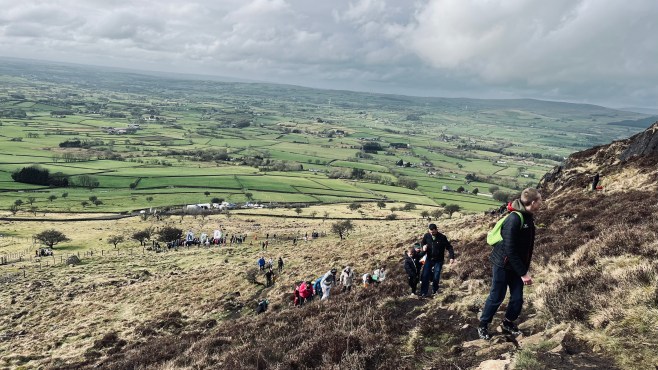
At just 437 metres high, technically this is not a mountain, but it is a tough little nut to crack! The path is very very steep – 29% gradient at one point. Underfoot the ground is extremely wet and slippy and there are lots of protruding sharp rocks to provide added danger. It’s not a place to go in runners – as many did today! I found this to be one of the toughest short rambles I’ve done in a long time and to see little kids scrambling past me was a little hard to take!
Start by taking the steps and after that pick your own path!
I’m not a fan of what St Patricks Day has become. Today was much more enjoyable for me than a lot of the paddy whackery we see typically associated with our celebrations of being Irish. I like the outdoors, solitude, visiting interesting places, heritage and history and today had all of that.
Saint Patrick is not the exclusive preserve of Catholics and Slemish of course is located in the ‘Bible Belt’ of the North. I got a lot of leaflets and pamphlets handed to me on my finishing the climb from different groups of evangelists. I’m not sure if they all work together or are separate distinct groupings.
Family group reach the New Cross on top of Slemish
I mentioned earlier that a Park and Ride system operated out of Broughshane. (I had come through Ballyclare to the start point). After I was directed there by two very helpful PSNI officers I saw a few people with their Orange sashes and bandsmen outfits. I thought it was a bit strange that the Orange order were taking part in the celebrations! It was only when I got home that I read an online article in the Irish News about disruption caused to pilgrims by an Orange March through the village which created huge delays for the pilgrim buses heading to Slemish. Luckily I missed all that. Somethings never change.