Rothar Routes

Cycle routes & pilgrim journeys in Ireland and Europe …..

Posts from the ‘Hill Walking’ category

Gods & Fighting Men

I was ten years of age when I first read this epic story of the Tuatha De Danann and of the Fianna of Ireland by Lady Gregory. It hooked me on Irish mythology and I still have my copy today. Funny the things you remember from childhood.

It’s been on my mind for some time to tie a trip north for a match with a climb up Slieve Gullion in South Armagh. Last week I managed both – I climbed Slieve Gullion on Sunday morning before heading into nearby Newry to see an epic encounter between the Gods & Fighting Men of Down and Monaghan club football clash in the Ulster Club SFC semi final!

The more I walk and cycle on this Emerald Isle the more I feel a close connection with the history, legends and culture of this great land. The beautiful thing about slow travel is you get to see over every ditch and through every hole in a stone wall. There is something of interest in every field in Ireland! Being curious brings great reward!

High point marker

Topiscope – places you can see on a clear day – it was raining when I was there so the views were limited!

Long before Fionn however was another great warrior – Cúchulainn who was part of the Ulster Cycle of Irish mythology. He is forever associated with the mountain as it is here he received his name and where he spent his childhood as Setanta. Conchobhar Mac Neasa, King of Ulster, was invited to a feast at the house of a local metalsmith Cualainn, after whom the mountain is named. The King was so enthralled watching the young Setanta hurling that he invited him into the feast. Before he arrives into the feast He is attacked by the King’s ferocious hound but Setanta killed him by hurling the sliotar down his throat! The King was devastated at the loss of the hound so Setanta took his place and earned the title Cú Chulain, the hound of Cualainn. Not men but Giants!

One of the stories in Book IV of Gods & Fighting Men, Huntings and Enchantments, relates the story of the Hunt of Slieve Cuilinn. Fionn Mac Cumhaill was hunting deer on the plains of Allen (Kildare) with his dogs, Bran and Sceolan , who got lost in the chase. He searched everywhere and ended up looking for them on the side of Slieve Gullion, where he met a beautiful woman keening beside the lake on top of the mountain. She begged him to find her lost ring at the bottom of the lake and being the Super Hero he was, he dived in, swam around it three times and found the ring! No sooner had he given it to her but didn’t she change into a witch and changed Fionn into an old man. Talk about gratitude! Cut a long story short but he finally got a cure in the passage tomb on top of Slieve Gullion, called the Cailleach Beara’s house. The Lake was called Loch Doghra, the Lake of Sorrow. Not sure if that name appears on modern maps though!

It’s only a short walk to the summit but a difficult one in wet conditions. The flag stones are slippy and the path steep. It was raining quite strong when I hiked it but occasionally the mist would clear and the views were spectacular. Had a great chat with a man from Mullaghbawn about our epic battle in the All Ireland Club semi final back in February 1996.

Slieve Gullion Hike

It was time to head to Páirc Esler for the clash of the Titans. Kilcoo v Scotstown. What an epic battle that Cúchulainn himself would have enjoyed. Heroic performances on both sides, capped with three incredible long range Scotstown points to win by the narrowest of margins!

This weekend I managed to pack in another trip to Newry for Steven Poacher’s hugely successful coaching day on Saturday and a trip to Westmeath today, Sunday, to climb the highest point in the Lake county before heading into Cusack Park for another cracking club championship game. Naas and St Lomans played out a great 90 minutes of football in Cusack Park, with Nass running out deserving winners and qualifying to meet Kilmacud Crokes in a repeat of the Final of two years ago. I had an early start this morning as I had to head past Mullingar and north through Castlepollard to reach Mullaghmeen Forest Park and the highest point in County Westmeath at 258 metres. This is the lowest county high point but a fairly tough little summit with an average 10% gradient for the last four hundred metres.

The highest point is located in the largest planted beech forest in Europe – almost 1,000 acres of forestry. A pity it wasn’t a few weeks ago as the colours would have been stunning. Unfortunately it was another day of heavy showers and the top was shrouded in a low lying cloud. There are a range of walking routes through the woods of beech, noble fir, Scots pine and sitka spruce.

There were great views of Lough Sheelin on Cavan as I approached he park but the views from the top were blocked by cloud and trees. I took the ‘blue route’ as that takes you up to the summit. Passed by an old Booley hut on the way down; this would have been used a shelter during summer grazing in years of yore and there are relics of famine walls built around old fields. Not to mention a few Turloughs too! (A turlough is a temporary or disappearing lakes!).

Mullaghmeelan Forest Park

Heading home from Mullingar, I took the back road towards Rhode with the intention of paying a visit to the Profundis Stone, which I had often seen signposted but never got to before. I’m glad I did as it is the only one left in Ireland. A Profundis Stone was a resting stone, a local tradition of stopping a funeral procession and reciting the “De Profundis” – Psalm 30. It is shaped like a coffin and here is a graveyard behind a locked gate on the opposite side of the road.

Well that was the last stop on another interesting ramble. I have it in my head to climb the highest point in each county over the next while. I have 12 completed already over the years so I will keep posting as I get around to the rest!

A Walk in the Burren

By the time we finished secondary school Leo McGough aka The Hurling Hobo, @thehurlinghobo, had enrolled us all in the cult of Clare hurling! So I have a soft spot for this beautiful county and I was delighted to take a break last weekend from my Darragh and Eimear’s wedding celebrations for a short walk in the Burren. It is the most unique landscape in Ireland, with its rolling limestone hills, underground rivers and caves, unique flora and fauna. An area steeped in history and heritage sites. It’s tricky walking territory and you need to focus on each step as the limestone is full of crevices and cracks, loose rocks and stone walls. That makes it hard to take in the natural beauty surrounding you, so it’s wise to stop and gaze as often as possible! Not everyone in the past was so taken with the wonders of the Burren:

“It is a country where there is not enough water to drown a man, wood enough to hang one, nor earth enough to bury him…. and yet their cattle are very fat; for the grass growing in turfs of earth, of two or three foot square, that lie between the rocks, which are of limestone, is very sweet and nourishing.”

Cromwellian general, Edmund Ludlow (1617-1692).

An Bhoireann….” a stony place..”. Never was a place so well named for this area of north Clare is world renowned for its unique landscape. Between those rocks and crevices is a unique eco system where alpine and mediterranean plant species are found side by side. It is a botanists paradise!

The Burren landscape was formed millions of years ago and there are clues to its ancient past in the rock surfaces, with fossils such as the coral below in abundance:

The Burren extends from approximately Corofin northwards into Galway, covering an area of about 530 square kilometres. A small part of that is designated a national park and thats where we completed this short walk around beautiful Mullaghmore mountain. The walk extends over a series of rocky terraces with beautiful lakes, some are turloughs (temporary lakes found in limestone areas), the colours of the water were stunning.

We often hear about the farmers in the Alps bringing their cattle to high pastures in the summer. This practice is called transhumance. For thousands of years, Burren farmers have marked the end of summer by herding their cattle onto ‘winterage’ pastures in the limestone uplands where they spend the winter grazing. This ancient reverse ‘transhumance’ tradition is synonymous with the Burren and is key to the survival of the region’s famous flora and fauna.

Farming practices in the Burren

6 Years a Slave….

A pilgrimage to Slemish Mountain

The story of Saint Patrick, Ireland’s Patron Saint, has been handed down to us over the centuries. It’s a great story in which it is hard to separate fact from fiction as there are scant contemporaneous records of his life in existence. I have some sympathy for poor Bishop Palladius who was sent here by Pope Celestine to spread the Gospel – before Patrick, but he gets little credit!

Patrick though wrote what must be a rare autobiography of an Irish Saint, his Confessio or Confession, which is his life story, though it lacks names and places, is an original source. And we can thank our own St Fiac, of Sleaty, (I often cycle past his cross in Sleaty graveyard, near Knockbeg College) who wrote his hymn on the Life of St Patrick:

He was six years in slavery;

Human food he ate it not.

Cothraige he was called,

for as slave he served four families.

Victor said to Milcho’s slave:

“Go thoust over the sea”:

He placed his foot upon the ‘leac’ (stone):

It’s trace remains, it does not wear away.

Life of St Patrick by St Fiac of Sleaty.

It’s pretty clear he was captured and brought to Ireland and the story is he spent 6 years as a slave of Milchú on Slemish Mountain (or Sliabh Mish) tending to flocks of sheep. This was one of those stories we learned in primary school; I was always fascinated by his time in slavery and so this was a place I have long intended visiting, and what better day to do it than on 17th March, the Feast Day of our National Saint. Slemish is located just outside Ballymena in County Antrim, a nice little drive! My route up took me past two very important sites central to the Patrick story – the Hill of Tara and the Hill of Slane. Had I more time I would have stopped off but it’s 293 kms, door to door, to the foot of Slemish! I’ve been on both these famed hills in the past and the story of the conversion of the High King of ireland is central to the conversion of Ireland to Christianity.

But after I reached Ireland I used to pasture the flock each day and I used to pray many times a day. More and more did the love of God, and my fear of him and faith increase, and my spirit was moved so that in a day I said from one up to a hundred prayers, and in the night a like number; besides I used wake up before daylight to pray in the snow, in icy coldness, in rain, and I used feel neither ill nor any slothfulness, because, as I now see, the Spirit was burning in me at that time.

And it was there of course that one night in my sleep I heard a voice to me: ‘You do well to fast: soon you will depart for your home country.’ And again, a very short time later, there was a voice prophesying: ‘Behold, your ship is ready.’ And it was not close by, as it happened, two hundred miles away, where I had never been or known any person. And shortly thereafter I turned about and fled from the man with whom I had been for six years, and I came, by the power of God who directed my route to advantage (and I was afraid of nothing), until I reached he ship.

Saint Patrick’s words form his Confession.

He was out of there!

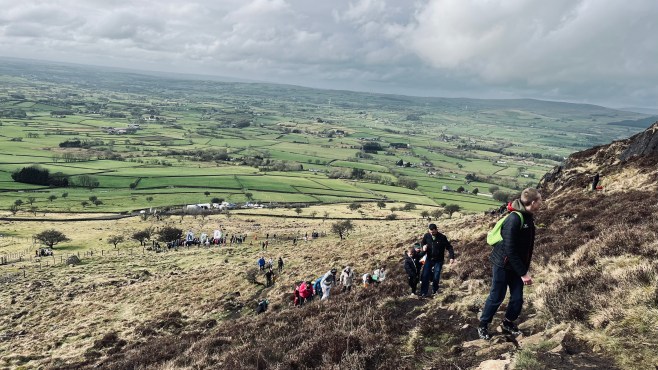
I thought there might be a few people walking the route to the top and it was shock to see Police bollards along the narrow local roads to prevent parking. There was a Park and Ride system in place from the village of Broughshane, about 7kms away. The mini buses were ferrying people all day long from 9am to the base of the mountain and they came from all over the north. I met quite a few from Derry and Tyrone including the father of Paul Wilson, who won an All Ireland Club medal all of 21 years ago with Ballinderry as an attacking half back. It was great to see families of Polish and Ukrainians, who made the hard trek up to the cross on the mountain top. And not a sign of a Far right protestor making the pilgrimage…

Hands and Knees Job!

At just 437 metres high, technically this is not a mountain, but it is a tough little nut to crack! The path is very very steep – 29% gradient at one point. Underfoot the ground is extremely wet and slippy and there are lots of protruding sharp rocks to provide added danger. It’s not a place to go in runners – as many did today! I found this to be one of the toughest short rambles I’ve done in a long time and to see little kids scrambling past me was a little hard to take!

Start by taking the steps and after that pick your own path!

I’m not a fan of what St Patricks Day has become. Today was much more enjoyable for me than a lot of the paddy whackery we see typically associated with our celebrations of being Irish. I like the outdoors, solitude, visiting interesting places, heritage and history and today had all of that.

Saint Patrick is not the exclusive preserve of Catholics and Slemish of course is located in the ‘Bible Belt’ of the North. I got a lot of leaflets and pamphlets handed to me on my finishing the climb from different groups of evangelists. I’m not sure if they all work together or are separate distinct groupings.

Family group reach the New Cross on top of Slemish

I mentioned earlier that a Park and Ride system operated out of Broughshane. (I had come through Ballyclare to the start point). After I was directed there by two very helpful PSNI officers I saw a few people with their Orange sashes and bandsmen outfits. I thought it was a bit strange that the Orange order were taking part in the celebrations! It was only when I got home that I read an online article in the Irish News about disruption caused to pilgrims by an Orange March through the village which created huge delays for the pilgrim buses heading to Slemish. Luckily I missed all that. Somethings never change.

Link to Irish News Article:

Orange Order parade in Broughshane causes upset and delays

Walk on the Hyne Side

I blame the wicked Algerian Pirates!

If Morat Rais and his band of Barbery Pirates had not sacked Baltimore in 1631 and forced the survivors to row up the Ilen River and establish the town of Skibereen, Éire Óg might well have been crowned All Ireland Club Champions in 1992!! Of course I jest but I found myself, accompanied by my good wife Mary in ‘Dear Old Skibereen’ at the weekend for a beautiful wedding of a lovely Carlow couple, Maeve and John. We had a few great days in the home town of the O Donovan Rossa Club, the team that beat us in that epic All Ireland Final, over two glorious games, in March 1993. Two games that really launched the Club Championship, drawing massive crowds to Croke Park and The Gaelic Grounds in Limerick.

Of course Skibereen, not being content to ‘keep its eye on the Czar of Russia’, has truly been placed on the World Map thanks to the exploits of its rowers especially the O Donovan brothers who really captured the heart of the nation.

It’s a great place to visit and, like a number of other west Cork towns, it has retained its charm. The town centre remains an historic busy market town. We’ve stayed in some lovely places up and down the country but I don’t think any come near to our three nights in the wonderful Bridge House B&B, run by hostess supreme, Mona Best! Her home is indescribable – a Victorian film set with every room uniquely furnished and decorated. You see something different every time you open a door. It is eccentric, exotic and quirky and it’s obviously a labour of love for Mona. Her beautiful organic breakfasts were the perfect start to the day. Words fail to do it justice, so here’s a few photos that may!

If you are ever in Skib, be sure to give Mona a call and she will look after you better than your own mother! With all those fine breakfasts and the beautiful food in the lovely West Cork Hotel, we needed to get out and about for a bit of exercise and exploring. The farmers markets of West Cork are famous – Skibereen has a great one every Saturday. West Cork is home to a lot of ‘blow ins’ who crave an alternative lifestyle and many of them are into organic food, art and crafts. It’s all there in the market!

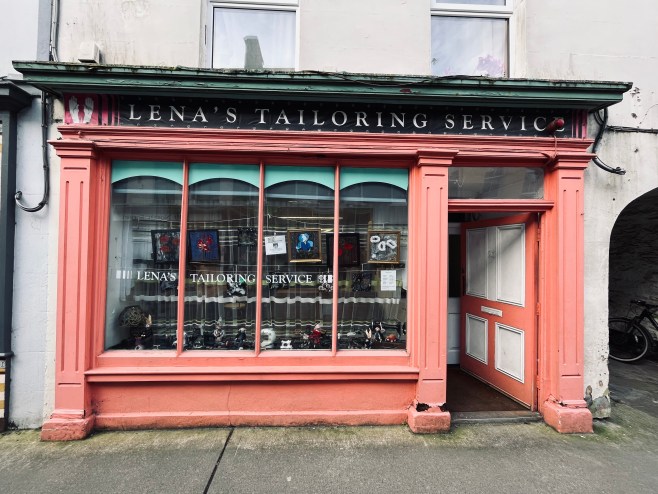
I love the multi coloured shop fronts and houses in West Cork, local shops with local produce, local book stores; Skibereen has its fair share of them, these caught my eye:

Obviously Lena was keeping an eye on us this weekend!
No weekend away would be complete without a cycle or a walk and doing it in West Cork is as good as it gets. We had a couple of walks out by Lough Hyne, one of them accompanied by our good friends Declan and Áine. What an incredible body of water! I have to go back in season to do the night kayaking. Lough Hyne is just 1km long and 3/4km wide, it is one of the most important marine habitats in Europe and was made Ireland’s first Marine Nature Conservation Reserve.

In the centre of the lake is Castle Island on which stand the ancient ruins of Cloghan Castle, once a stronghold of the O’Driscolls. According to local folklore here lived King Labhra Loinseach, who had asses ears, a story we learned in primary school and it was great to visit the area!

Lough Hyne Loop Walk

We did a beautiful looped walk, we thought it would circle the lake but it actually turns west in the direction of Baltimore and it’s a lovely scenic 5kms of road walking. There’s a few nice hills on it and we ‘had to pull like dogs’ to get up them! I mentioned the sacking of Baltimore earlier; that was areal event that occurred when Barbery pirates attacked the village and captured over 100 locals which they brought back to North Africa and sold into slavery. It’s an astonishing little known piece of our unique history which I read about about a few years ago in a terrific book, ‘The Stolen Village’ by Des Ekin;

All in all a great weekend in ‘Dear Old Skibereen’.

Aghaviller revisited.

Saturday night National League games are great! A big crowd in Netwatch Cullen Park to witness the opening game between Carlow and Wicklow which ended with honours even. That left Sunday free and a chance for a walk in the woods and plenty of fresh air! Christopher Somerville wrote a lovely book titled ‘Walking in Ireland’ with 50 walks scatttered across the country. Many of them featured in the Irish Independent and I was always taken with his beautiful sketch maps incorporating some lovely detail of things to watch out for.

The last time I was in Aghaviller was when I cycled through on an 80km loop out of Inistioge; I had a rest stop here and I was taken with the beautiful church ruins and Round Tower of this ancient site. Today I was out walking and I took the purple route through Castlemorris Woods which was a gentle 8kms with 170 metres of ascending.

Starting point

It was a bit of an experiment today- I recently purchased a set of trekking poles to get my arms working more and assist with rehab. Although I’m still getting used to them they were great! I could really feel the benefit of the pushing action to activate my triceps and it’s a great way to get more from a walk than just leg exercise. The poles take pressure off the hips and knees. I’ll keep them in the car for future walks and handy for fending off any hungry dogs!

Every walk is different and while most of this route is encased in the forest, it’s a nice change of scenery, the surfaces are good and there’s a nice uphill pull in the middle section. This part of Kilkenny has some interesting heritage sites and makes for a good day out of you like to delve into our ancient past. Aghaviller has a terrific church ruin with a tricky staircase that you can climb to the roof which affords a fabulous view of the round tower.

Áth an Bhiolar (Field of the Watercress) was mentioned in the Annals of the Four Masters

Inside Aghaviller Round Tower
Aghaviller Church ruins
Tomb with wreath in Aghaviller Church ruins

I took Christopher’s suggestion on the way home and had a short stop off at Gáirdín an Ghorta, The Famine Garden. It’s so easy fly pass these little places and I was glad I did. The Great Famine was such a tragedy that decimated this country, sending millions to early graves or onto coffin ships looking for new beginnings in far off lands. Its a worthy memorial to our dark history.

Gháirdín an Ghorta
Gháirdín an Ghorta
Gháirdín an Ghorta